Module 1
Foundations
Purpose, Rationale and Certification
Establishes why every person leaving the planet should be trained in this skill, defines the skill precisely, and sets out what the learner must demonstrate to be certified.
A Certification Course for Off-Planet Crews

Patch awarded on certification
A structured practice that teaches crew members to start from one shared point on the Earth, find their way from it to the figures that carry its stories, keep the planet in view when it can no longer be seen from the window, and carry those stories to the people who will be born beyond it.
Source corpus: “Heaven on Earth: As Above, So Below” · © A2A World LLC 2026
Purpose
Space programmes prepare crews to operate, maintain and survive. This course prepares them to remember. Crews leaving Earth face three pressures that grow with distance and duration, and the course is designed around all three.
A crew member who understands the reason for the practice is far more likely to keep using it when no one is asking them to.
Distance and the fading view. In low Earth orbit the planet fills the window. On the way to the Moon it becomes a globe; on the way to Mars it becomes a point of light. The sense of connection that depends on seeing the whole Earth weakens as the view recedes.
Isolation, confinement and monotony. Long-duration crews live in small spaces with the same few people and routines for months. They need activities that are absorbing, self-directed, rewarding and possible with very few resources.
The continuity of heritage. The first settlers will be people of Earth. Their children will be born elsewhere, and within a few generations Earth may become a place their descendants have only heard about. What is not deliberately carried forward will be lost.
The Skill
Pareidolia is the universal human tendency to perceive meaningful forms — most often faces and figures — in random patterns such as clouds, rock or terrain. It is not learned, and it is not limited to any culture. Every crew member already has it.
Deliberate pareidolia turns that tendency into a trained practice. Every learner starts from the same place: Ground Zero, the Beautiful Flower. Given a search area but not the answer, they find it by eye, then block, refine and layer it until it pleases their own eye. From that shared origin, directions lead to the other figures of the Earth and the stories they carry.
1
Every crew member finds the same first figure, the Beautiful Flower, so every crew member shares the same origin. How each one blocks, refines, colours and layers it is their own.
2
Each recognition is a small discovery, and discovery is intrinsically motivating. The practice draws people back without being scheduled.
3
Every session is time spent closely studying the home planet through the stories of its people — even when the planet itself is no longer visible.
The Course
Module 1
Purpose, Rationale and Certification
Establishes why every person leaving the planet should be trained in this skill, defines the skill precisely, and sets out what the learner must demonstrate to be certified.
Module 2
Ground Zero: The Beautiful Flower
Every crew member’s first guided search. Given a search area, not an answer, each learner finds the Beautiful Flower by eye, blocks, refines and layers it, and fixes it as Ground Zero for every later direction.
Module 3
The Elder Astronaut and Certification
Gives the practice its long-term purpose: preparing every certified crew member to carry Earth’s stories to those born beyond it, and setting out how to get verified as an Elder.
Certification
Continuity
Permanent settlement changes the problem from one person’s well-being to the memory of a community. Each generation stands in a different relation to Earth.
First: the settlers
Second: their children
Third and beyond
| Generation | Relation to Earth | Risk |
|---|---|---|
| First: the settlers | Born and raised on Earth. Earth is home, memory and family. | Homesickness and isolation; the fading view of the planet. |
| Second: their children | Born off-planet. Earth is the place their parents describe. | Earth becomes a story rather than an experience. |
| Third and beyond | Know Earth only through what they have been told. | Earth is remembered as the home of other people — “the people in the sky” — rather than as their own origin. |
“The break, if it comes, will not happen at once. It happens when one generation stops telling and the next stops asking.”
Module 3 · Continuity
The Elder Astronaut
An Elder Astronaut is a certified crew member who accepts responsibility for carrying Earth’s stories off the planet and passing them on. The title does not depend on age or rank. It describes a commitment: that the stories of the Earth, and the knowledge of where they come from, will not end with the person who carried them.
More about the Elder Astronaut →Maintain a personal portfolio that begins at Ground Zero, the Beautiful Flower, and leads by directions to the figures and stories they are ready to tell.
Retell those stories aloud, using the map, to crewmates and to those born off-planet.
Guide others — adults and children — through their own Ground Zero search, so that the practice continues.
Hold every tradition with care and never present one culture’s story as the only way of seeing the Earth.
The ELDER Patch
A circle within a circle. The red outer ring carries the word ELDER and the year of certification. Within the gold dividing ring, a navy field holds Metatron’s Cube — thirteen circles joined by gold lines — for the Elder’s task of connecting people, stories and the Earth. Awarded only on certification.
The most important audience for an Elder Astronaut is a child who has never seen Earth. On Earth, a story is often told where it happened. Off the planet, that is impossible. The map restores it.
Begin with the place. Show the region of the Earth before telling the story. Let the child look first.
Let the child find it. Their own recognition is the moment the story becomes theirs.
Use the shape of the Earth, not the names on it. Borders change; coastlines, mountains and rivers endure.
Tell it the same way each time. Consistency allows a story to pass intact from one generation to the next.
Make the connection explicit. This is the planet the child’s family came from, and these are the stories of their people.
Invite the next telling. Ask the child to tell the story back, and later to tell it to someone younger.
Reference Demonstration
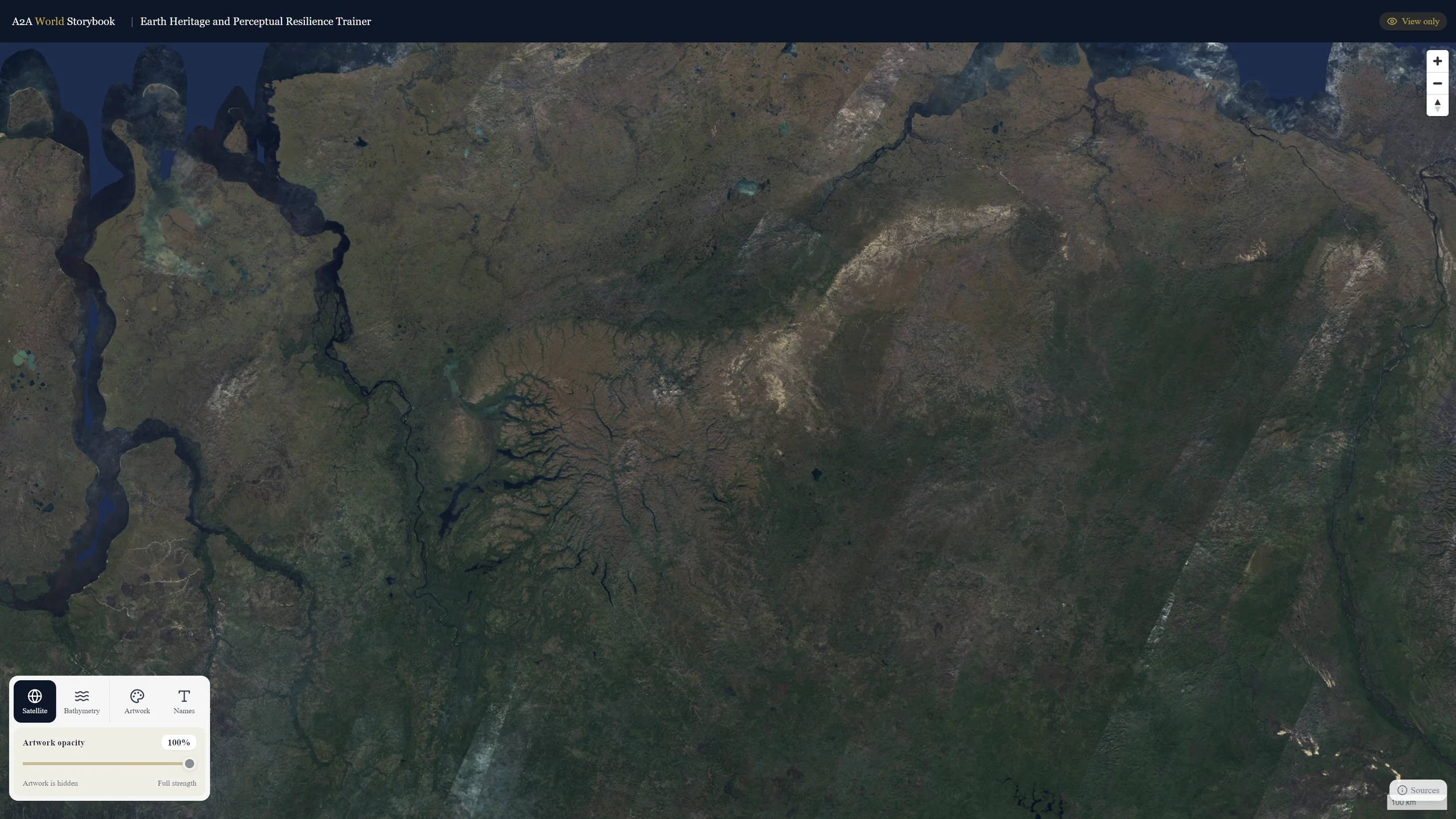
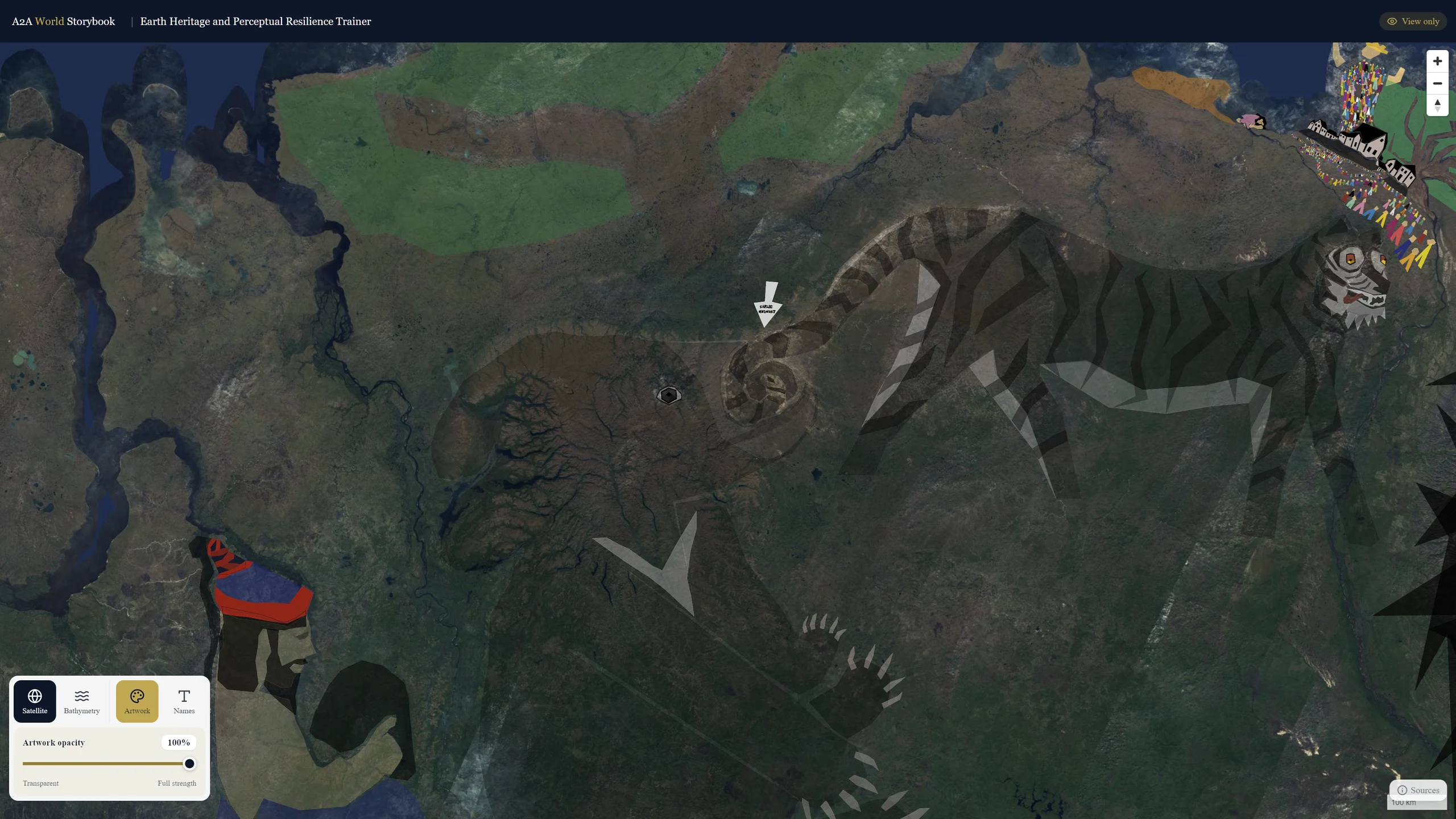
The Dangun narrative is the foundation story of Korea. Hwanung descends from Heaven to a sacred tree on a mountain and founds a city. A bear and a tiger come to him wishing to become human. He gives them mugwort and garlic and tells them to remain out of the sunlight. The tiger gives up; the bear endures and becomes a woman. Her son, Dangun, goes on to found the first Korean kingdom.
The practitioner had never read a Korean myth before beginning. Working from a field guide, he searched the imagery for the narrative and, within three days, had located a sequence of its elements across the North Asian and Siberian region — among them the bear, the tiger and the sacred tree.
Status of this evidence
The Source Corpus
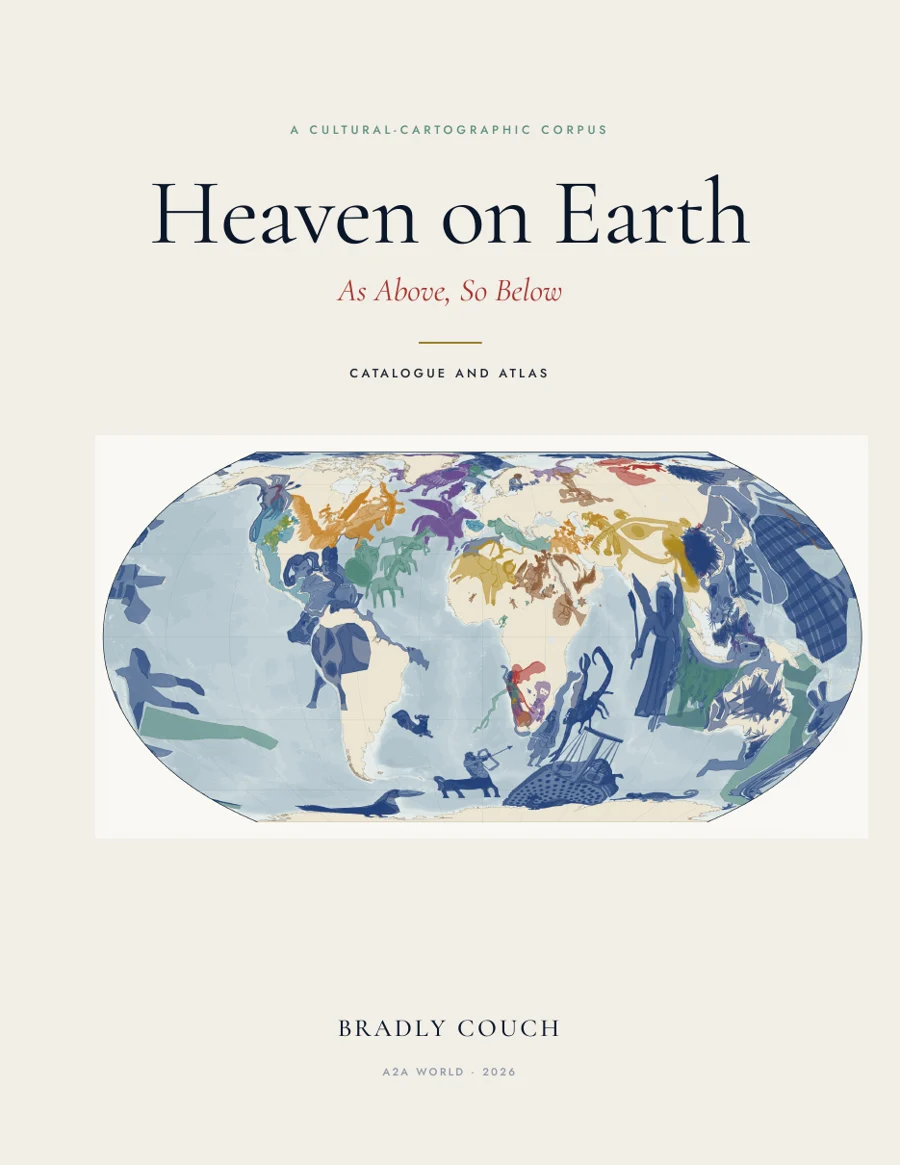
The course draws its worked examples from a registered body of interpretive artwork by Bradly Couch, in which figures from the world’s myths and traditions are traced as precise line overlays upon satellite and bathymetric imagery of the Earth.
The corpus is presented as art and as a training practice — never as a scientific or historical claim that the figures were placed in the landscape. Every tradition holds equal standing.
8,213 placemarks · 149,410 traced vertices · 216 works · nine cycles
© A2A World LLC 2026 · First edition
For Delivering Institutions
Faculty-led. Session timings, assessment standards and certification criteria are proposals, to be set and approved by the delivering institution’s faculty.
Complementary. The course sits alongside existing physical, medical and technical training; it replaces no part of it.
Low-equipment. The practice needs Earth imagery, simple drawing tools and time.
Learner-owned. Personal portfolios belong to the learners who make them.
Earned, not issued. The ELDER patch is awarded only to learners who complete certification.
Enquiries
Institutions interested in reviewing or co-developing the course are welcome to write.
[email protected]Reference Library
Fifteen field guides gather the principal figures, stories and symbols of the world’s great mythological traditions, each with a note on what to look for in the land. Every guide can be saved as a PDF.
Questions
It is a certification course for off-planet crews: one course, three modules — Foundations, Practice and Continuity — and one certification. Every crew member begins at the same Ground Zero, the Beautiful Flower, and learns to find their way from it to the figures that carry Earth’s stories, to keep the planet in view when it can no longer be seen from the window, and to carry those stories to the people who will be born beyond it.
Every person preparing for long-duration spaceflight or permanent settlement beyond Earth, and the training institutions that prepare them. It is designed to sit alongside existing physical, medical and technical training and replaces no part of it.
Pareidolia is the universal human tendency to see meaningful forms, such as faces and figures, in random patterns like clouds, rock or terrain. Deliberate pareidolia turns that tendency into a trained practice. Every learner starts by finding the same figure, the Beautiful Flower, from a search area with no answer given. It becomes Ground Zero, and every later figure and story is reached by directions from it.
Ground Zero is the Beautiful Flower: the first figure ever traced in the A2A World corpus. In Module 2 every crew member finds it by eye, then blocks, refines and layers it until it pleases their own eye. From then on, directions are given as a bearing and a distance in flower widths (one flower width is about 85 kilometres), never by modern place names.
No. In the course’s reference demonstration, a practitioner with no prior exposure to Korean myth located elements of the Dangun narrative within three days using a reference guide. Learners begin at Ground Zero, and the stories come with the figures they reach from it.
A certified crew member who accepts responsibility for carrying Earth’s stories off the planet and passing them on — to crewmates and to children born off-planet. The title does not depend on age or rank. It describes a commitment to carry, tell, teach and respect.
In four stages. Complete all three modules, including the Ground Zero search and the first portfolio entry. Live with the stories for as long as you need, following directions from the flower to further figures and telling their stories aloud. Book a capstone yourself on the rolling Elder review calendar when you feel ready. Then, before a review panel, give directions from Ground Zero, tell the stories from memory using the map, and guide someone through their own Ground Zero search. Learners are assessed on completion, engagement and the quality of the telling, never on whether an assessor sees the same figures. Certified learners receive the ELDER patch.
Imagery of the Earth, simple drawing tools and time. It adds no mass and no dependence on communication with Earth, which is why it suits long missions.
No. Figures found through the practice are acts of interpretation and art. They make no claim that anything was placed in, or is objectively present in, the landscape. Every tradition holds equal standing.
Not yet. Its benefits — sustained connection to Earth, relief from monotony, crew cohesion and the continuity of heritage — are proposed outcomes. The course is designed to be delivered alongside evaluation with validated measures, and to be tested first in an analog environment before use in flight.